
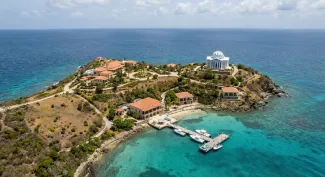
Little St. James Island emerges from the turquoise waters south of St. Thomas like a footnote that somehow became the headline. A seventy-acre speck of land that has inspired more curiosity, speculation, and whispered commentary than islands twenty times its size. No landing is permitted. No tours dock at its shores. The island remains firmly and irrevocably private, its beaches and structures visible only from the respectful distance of surrounding waters. This is not an oversight in Caribbean tourism planning. This is by design, legal necessity, and frankly, common sense. You should definitely not try to visit it. Obviously.
What follows, then, is not a guide to trespassing, because that would be both illegal and deeply unwise, but rather a guide to the art of seeing something without actually going there. Think of it as a peculiar sort of safari. You are in the right waters, on the right side of maritime law, observing from afar a place that once hosted people who probably should have stayed home, while focusing on what actually makes the U.S. Virgin Islands remarkable. World-class snorkeling that predates modern scandal by several millennia. Crystalline waters that remain blissfully indifferent to human drama. Marine life that congregates around the Ledges of Little St. James for reasons that are entirely ecological and refreshingly innocent. The island itself is merely context. The reef is the point.
From a practical standpoint, positioning yourself for these observations requires the same planning any sensible expedition would demand. You secure the right accommodations on St. Thomas or St. John. You understand the ferry systems that knit the islands together. You select watercraft appropriate for the three to five miles of open ocean separating civilized docks from places best admired at a distance. What emerges is an itinerary that serves two purposes at once. It satisfies natural curiosity about a place that once made headlines, while genuinely exploring some of the Caribbean’s most pristine maritime environments. The USVI also offers the rare luxury of no passport requirements for American citizens, making this one of the most accessible tropical destinations for travelers whose passports are expired, misplaced, or buried in a drawer under old boarding passes.
Let us begin where all sensible expeditions begin, with arrival logistics.

1. Getting to the USVI: Your Gateway to Island Hopping
Cyril E. King Airport on St. Thomas serves as your entry point, receiving direct flights from major American hubs including Atlanta, Miami, New York, and Charlotte. The absence of customs requirements for U.S. citizens makes this one of the smoothest Caribbean arrivals you will experience; you collect your luggage and proceed directly to ground transportation without the usual passport queues that characterize most island arrivals. For February 2026 travel, book flights at least eight to twelve weeks in advance to secure reasonable rates during what remains high season in the Virgin Islands.
Major carriers serving the route include American Airlines, Delta, United, and JetBlue, with multiple daily frequencies that provide flexibility should you miss connections or need to adjust travel dates. Morning departures from the East Coast typically arrive by early afternoon, granting you several productive hours of daylight to position yourself at Secret Harbour Beach Resort or secure that afternoon's sunset charter. The airport sits on the western edge of St. Thomas, approximately twenty-five minutes by taxi from Red Hook on the eastern end, where most ferry services and private charters depart.
Ground transportation options include taxi vans (operating on fixed routes and shared-ride pricing, typically $15-25 per person to Red Hook), private car services ($75-100 for direct service), and rental cars if you plan extended exploration of St. Thomas itself. The island drive from airport to Red Hook follows scenic coastal roads with periodic views across Pillsbury Sound toward St. John, offering your first glimpses of the waters you will soon navigate by boat. Safari-style open-air taxis provide the most atmospheric introduction, though air-conditioned sedans may appeal to those arriving during the humid midday hours.
Pro tip: Book airport transfers in advance through your accommodation; most quality properties arrange reliable drivers who meet you at baggage claim, eliminating the scramble for taxis during the occasional cruise ship surge that floods the airport with day-trippers returning to their vessels.
2. The Public Ferry Network: Mastering St. Thomas to St. John
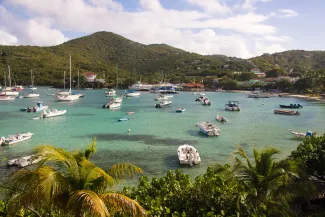
Red Hook ferry terminal operates the USVI's most frequent inter-island service, with departures to Cruz Bay on St. John running from 5:30 AM through 11:30 PM daily. This represents your foundational transportation link, connecting St. Thomas' eastern infrastructure to St. John's charter operators and positioning you within striking distance of Little St. James' southern waters. The crossing takes twenty-five to forty-five minutes depending on vessel and sea conditions, with operators including Native Son, Varlack Ventures, and Transportation Services running the route on rotating schedules.
Current 2026 pricing holds at $8-15 one-way for adults, with children typically half-price and infants free. Return trips offer slight discounts when purchased together, though the independent nature of operators means you can mix vendors based on schedule convenience rather than ticket restrictions. These are working ferries primarily serving residents, not tourist excursions, which grants them a utilitarian efficiency absent from more polished operations. Expect bench seating, occasional cargo sharing deck space with passengers, and captains who navigate by instinct developed over decades of reading these particular waters.
Charlotte Amalie, the capital on St. Thomas' southern shore, offers an alternative ferry route with less frequent departures at 10:00 AM, 3:00 PM, and 5:30 PM. This proves useful if your accommodation sits on the western end of the island or if you wish to spend mornings exploring Charlotte Amalie's Danish colonial architecture before afternoon charter departures. The trade-off involves longer crossing times (up to an hour) and less scheduling flexibility for connecting to private boat operators.
These ferries matter beyond simple transportation; they position you strategically for the private charters and water taxis that actually approach Little St. James. Cruz Bay on St. John serves as a secondary departure point for several snorkel tour operators who include the Ledges in their itineraries, while Red Hook's proximity to the island (roughly three nautical miles) makes it the preferred launching point for direct viewing trips. Understanding ferry schedules allows you to coordinate multi-modal journeys: perhaps an early Red Hook departure to St. John for morning snorkeling, followed by an afternoon private charter from Cruz Bay that swings past Little St. James on the return to St. Thomas.
Pro tip: Purchase tickets at the terminal rather than online; the small operators often run cash-preferred operations, and ticket windows open thirty minutes before first departures, eliminating any advance booking premium while ensuring seats during the typically uncrowded shoulder hours.
3. Private Water Taxis: Your Direct Route to Discrete Observation
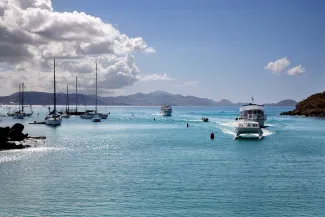
Private water taxis occupy the middle ground between public ferries and full-day charters, offering point-to-point service with flexibility to accommodate brief circumnavigations of islands that pique curiosity. Island Time Water Taxi operates from Red Hook with twenty to twenty-five minute runs to various destinations, including custom routes that pass Little St. James at the legally appropriate distance. Pricing runs $100-300 per person depending on group size and routing, with significant per-person savings once you reach four to six passengers splitting the boat cost.
The booking process typically involves direct contact via phone (+1 284-340-0357) or their website, where you outline desired departure times and destinations. For Little St. James viewing, clarify that you understand no landing is permitted and that you seek a circumnavigation from safe distance. Reputable operators appreciate this clarity; it distinguishes genuine maritime interest from those harboring unrealistic expectations about beach access. The vessels themselves tend toward twenty-five to thirty-foot center consoles or small cruisers, offering shade canopies, basic seating, and occasionally a cooler for beverages.
What to expect during the actual approach: your captain will maintain several hundred yards offshore, circling the island's perimeter over approximately thirty to forty minutes. You will observe the dock structures on the southwestern shore, the buildings set back into vegetation on higher elevations, and the rocky formations that characterize the coastline. Conversation typically turns to the island's history, local speculation, and more positively, the remarkable marine habitat that surrounds it. Photographers appreciate the slow circling that allows shots from multiple angles, though the distance means telephoto lenses become necessary for any architectural detail.
The experience bears comparison to a game drive with more legal disclaimers. You are observing from a vehicle (in this case, aquatic) a site of public interest, maintaining proper distance, not disrupting the environment or trespassing on private land. Early morning and late afternoon provide the best natural light, with calm seas typically prevailing before 10:00 AM and after 3:30 PM when afternoon breezes subside. Sea conditions matter more than you might anticipate; even three-foot swells make photography difficult and comfort levels decline sharply for those prone to motion sensitivity.
Pro tip: Combine the Little St. James viewing with practical destinations like Turtle Cove or the Christmas Cove snorkeling sites on neighboring Great St. James, transforming what could be perceived as morbid curiosity into a legitimate marine exploration with the infamous island as merely one waypoint among several.

4. Snorkeling Tours: The Ledges of Little St. James
Here is where observation gains genuine justification: the Ledges of Little St. James rank among the USVI's premier snorkel sites, predating any human notoriety by geological epochs. Ocean Surfari's St. James Snorkel & Pizza Pi tour departs Red Hook at 8:30 AM, running three and a half hours for $147.55 per person as of 2026 rates. This represents the most ethically defensible way to experience Little St. James, as the reef structures care nothing for property lines and the marine life congregates here for reasons entirely ecological.
The Ledges themselves consist of pillar coral formations, rock outcroppings, and sandy channels at depths ranging from twenty to forty feet, accessible to snorkelers comfortable with moderate depths and light currents. Green sea turtles glide through with remarkable frequency, hawksbill turtles browse the coral for sponges, southern stingrays rest in sandy patches, and Caribbean reef octopuses inhabit the crevices with shy intelligence. The coral structures create overhangs and small caverns that shelter juvenile fish, while the deeper channels attract larger pelagics during certain tidal movements.
The MV Island Flyer operates a similar four-hour tour for $150, departing from both St. Thomas and St. John with 103+ reviews on TripAdvisor averaging 4.5 stars. Both operators include all snorkel gear, basic instruction for novices, and free cancellation policies up to twenty-four hours before departure (critical during February when occasional weather fronts sweep through). The Pizza Pi component deserves mention: a floating pizza boat anchored near the snorkel sites serves fresh pies that you consume while bobbing in crystal waters, a surreal Caribbean experience that somehow works perfectly.
What makes this approach elegant is the inversion of priorities. You book primarily for world-class snorkeling that happens to occur around an island of historical infamy, rather than booking a gawking tour with snorkeling as afterthought. The distinction matters both ethically and experientially; your day focuses on marine observation, with the island's structures providing merely background context. Guides typically offer brief historical commentary during transit but emphasize the reef ecology once in the water, which reflects proper priorities for anyone claiming genuine interest in Caribbean environments.
Expect small groups (typically ten to fifteen snorkelers), morning departures that catch optimal light penetration into the water column, and two to three separate snorkel sites including stops at neighboring Turtle Cove and Christmas Cove. Reef-safe sunscreen is mandatory (and enforced by conscientious operators), underwater cameras are welcomed, and moderate swimming ability is expected though flotation devices are available for anxious swimmers.
Pro tip: Book the earliest available departure; morning waters offer the best visibility before afternoon breezes stir up particulates, and you will share the sites with fewer boats, creating a more contemplative experience appropriate to observing ecosystems that will outlast all human scandals.

5. Private Boat Charters: Bespoke Island Viewing
Full-day private charters represent the luxury approach, offering complete control over itinerary, timing, and the balance between sightseeing and snorkeling. The 'Best of USVI' charter runs $1,295 for groups up to eight passengers, covering six hours with 573+ reviews averaging 4.7 stars on GetMyBoat and TripAdvisor. This rate includes captain, fuel, snorkel gear, beverages, and the flexibility to customize routing based on your specific interests, whether that prioritizes Little St. James viewing, secluded beach stops, or extended time at premium snorkel sites.
Local Legend LL2 offers even greater flexibility with charters from one to eleven hours starting at $355 for shorter durations, scaling up based on time and fuel consumption. Half-day privates typically run $795+ for groups up to eight, providing four hours of cruising that proves sufficient for a Little St. James circumnavigation, one or two quality snorkel stops, and a beach lunch at one of the uninhabited cays that dot these waters. The vessels range from thirty-two foot center consoles to forty-five foot cruisers, with larger boats offering shade structures, marine heads, and greater stability in open water.
The booking process through platforms like GetMyBoat or direct contact with marinas like Yacht Haven Grande in Charlotte Amalie allows detailed discussion of your objectives. Reputable captains will outline exactly what Little St. James viewing entails (offshore observation only), suggest optimal combinations with snorkeling sites, and recommend timing based on tides, weather patterns, and your photography priorities. This pre-trip consultation proves invaluable; it aligns expectations and often surfaces local knowledge about lesser-known snorkel sites or secluded beaches that justify the private charter premium.
Wilson's luxury angle: sunset sails with champagne transform the experience from curiosity-driven viewing to genuine maritime elegance. As afternoon light turns golden across the water, approaching Little St. James with a glass of Veuve Clicquot while your captain discusses the island's ecological role in local currents creates a civilized distance from sensationalism. You are, in this context, engaged in the time-honored tradition of coastline observation, that peculiarly human practice of contemplating landscapes from the sea that stretches back to the earliest maritime cultures.
Several operators explicitly list Little St. James in their itinerary options, including Over The Line Charters (OTL) which runs $1,250 for eight-hour full days on vessels ranging from thirty-five foot Scarabs to fifty-foot Sea Rays. Their marketing explicitly mentions "stunning BVI views without landing restrictions," acknowledging the island's status while positioning visits as part of broader regional exploration. This transparency proves refreshing compared to operators who avoid mentioning the island despite regularly passing it during standard routes.
Pro tip: Request departure from Red Hook rather than Charlotte Amalie; the fifteen-mile difference cuts an hour from round-trip transit time, granting you substantially more time in the actual waters around Little St. James and neighboring snorkel sites, which matters considerably on four-hour charters where transit can otherwise consume half your window.

6. Bareboat Zodiac RIB Rentals: The Adventurer's Choice
Self-drive rigid inflatable boats (RIBs) grant maximum autonomy for experienced boaters comfortable navigating USVI waters independently. St. John-based operators rent twenty to twenty-four foot Zodiacs for $595 covering four to eight hours, receiving 110+ reviews averaging 4.6 stars from adventurers who prize the freedom to create custom routes. These represent serious watercraft: twin outboards providing thirty to forty knots cruising speed, GPS navigation with pre-programmed waypoints, VHF radios, safety equipment, and capacity for six to eight passengers.
The appeal lies in absolute control over timing and positioning. You can linger at the Ledges for two hours if the turtle concentration proves remarkable, swing past Little St. James mid-morning when light angles favor photography, then beach the RIB at uninhabited Christmas Cove for lunch without any charter captain's schedule dictating your movements. For photographers serious about marine work, this flexibility proves invaluable; you return to sites when conditions optimize, wait out passing squalls without rental meter anxiety, and explore secondary locations that pique interest without group consensus requirements.
Requirements include demonstrated boating experience (operators verify through conversation and occasionally require certification), familiarity with GPS navigation, and understanding of local maritime regulations including restricted areas, speed zones near shore, and the critical understanding that private islands like Little St. James prohibit landing regardless of your rental agreement. The pre-departure briefing covers these legalities explicitly, provides GPS waypoints for approved snorkel sites and anchorages, and includes emergency contact protocols should weather or mechanical issues arise.
Best practices for Little St. James approach: maintain 200+ yards offshore, cut speed to minimize wake near the coastline, respect any Coast Guard or local enforcement instructions should patrol boats appear, and combine viewing with legitimate activities like snorkeling or fishing. The Ledges waypoint will already exist in your GPS; approach from the south, anchor in sandy patches away from coral (your briefing will detail these), and snorkel the formations that made this site famous long before its terrestrial notoriety.
Safety considerations matter more than casual boaters sometimes acknowledge. Open water between St. Thomas and St. John experiences afternoon wind chop that builds three to five-foot seas, strong enough to make inexperienced operators uncomfortable and potentially dangerous for children or elderly passengers. Morning departures (8:00-10:00 AM) offer optimal conditions, while afternoon returns (2:00-4:00 PM) should account for building seas. Weather apps specific to marine conditions (Windfinder, PredictWind) become essential tools for planning your window.
Pro tip: Rent for full eight hours rather than four-hour minimums; the $50-75 difference proves negligible compared to the flexibility gained, and the 2:00 PM return time forced by half-day rentals often coincides with peak afternoon chop, while full-day allows you to wait out rough patches at protected anchorages before calmer evening transits.
7. Kayaking Realities: Why This Isn't Your Best Bet
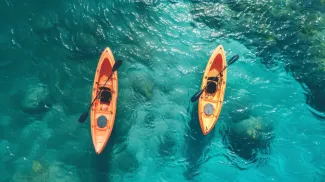
Honesty compels acknowledging that kayaking to Little St. James represents poor judgment bordering on recklessness. The three to five miles of open ocean from nearest practical launch points, combined with strong currents flowing through Pillsbury Sound, persistent afternoon winds, and complete lack of shade or rest points, creates conditions unsuitable for all but expert blue-water kayakers. No rental operators offer guided kayak trips to Little St. James, which reflects sound risk management rather than oversight.
The physics work against you: even strong paddlers average three to four miles per hour in touring kayaks, meaning the outbound leg alone consumes sixty to ninety minutes of continuous paddling with no current assist. Return trips often face prevailing easterly winds that turn the journey into a grinding slog, with fetch across miles of open water building seas that swamp recreational kayaks with alarming ease. Add tropical sun exposure, the absence of support vessels, and the reality that even slight injuries or equipment failures become serious emergencies when you float miles from land, and the case against kayaking becomes overwhelming.
For those who arrived hoping kayaks offered budget access to Little St. James waters, redirect that adventurous impulse toward appropriate kayaking in the USVI. The Westin Frenchman's Reef offers guided night kayaking tours for $69 through bioluminescent waters in protected bays, where you paddle above underwater lights that attract fish and occasionally turtles. This provides genuine kayaking experience in environments suited to the craft's capabilities, rather than undertaking open-water crossings that exceed recreational equipment's design parameters.
St. John offers extensive kayaking opportunities along its protected north shore, where gaps of 500 yards to half-mile between beaches create manageable legs with frequent landing options. Trunk Bay to Cinnamon Bay, Maho Bay explorations, and the mangrove creeks on the eastern end all provide rewarding paddling that respects both your safety and the equipment's limitations. Several operators rent sit-on-top kayaks for $35-65 per day from Mongoose Junction and Cruz Bay outfitters, appropriate for coastal exploration rather than open-water transits.
Wilson's perspective proves blunt: some expeditions demand motorized craft, and this represents one of them. Safari vehicles exist because walking among lions demonstrates poor survival instinct; similarly, approaching Little St. James requires boats designed for the mission. Kayaking offers profound rewards in appropriate contexts; attempting it here demonstrates the dangerous confusion of adventure with foolhardiness.
Pro tip: If kayaking appeal stems from silent, low-impact observation, consider early morning RIB rentals where you motor to site then drift with engines off; this provides kayaking's contemplative quality without the dangerous transit, and allows you to photograph or snorkel without the safety compromises inherent in blue-water paddling.
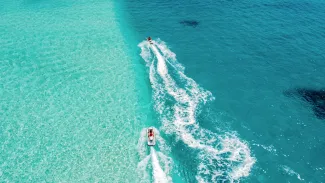
8. Jet Ski Options: Limited but Thrilling
Personal watercraft rentals in the USVI face regulatory and practical limitations that eliminate them as viable Little St. James viewing platforms. No operators offer dedicated jet ski charters for the three to five mile open-water run to the island, reflecting fuel range concerns, safety protocols, and the fundamental unsuitability of stand-up or sit-down PWCs for extended ocean transits. The craft excel at coastal exploration and beach-hopping within protected waters, but lack the fuel capacity, stability, and emergency equipment appropriate for the distance involved.
General USVI jet ski rentals exist through various water sports operators along St. Thomas' north shore and St. John's west end, typically charging $90-150 per hour or $350-500 for half-day periods. These serve perfectly legitimate purposes: exploring accessible coastlines, reaching small beaches visible from rental points, and providing thrilling rides through turquoise waters at speeds up to fifty miles per hour. The limitation involves range and legal access, not capability; theoretically a modern jet ski could reach Little St. James, but rental agreements explicitly prohibit such distances, liability concerns prevent operators from approving it, and fuel consumption at cruising speeds means you would arrive with insufficient reserves for safe return.
The alternative that captures some of jet skiing's appeal: Turtle Cove Catamaran tours to Little Buck Island run $119 and combine sailing with water sports including complimentary use of paddleboards and floating mats, approximating the playful water engagement that attracts jet ski enthusiasts. While you won't pilot your own craft, the sailing catamaran reaches sites inaccessible to most motorized traffic, and the afternoon itinerary includes snorkeling stops where you can swim freely without the structured nature of guided tours.
Best use of jet skis for USVI exploration involves accepting their role as coastal craft rather than open-water vessels. Sapphire Beach to Coki Point runs (approximately two miles along St. Thomas' north shore) provide thrilling riding through protected waters with multiple beach landings. St. John's Cruz Bay to Caneel Bay stretch offers similar distances with spectacular scenery and calm seas ideal for intermediate riders. These trips deliver authentic Caribbean jet skiing without the range anxiety and safety concerns that plague longer passages.
The reality some visitors resist acknowledging: Little St. James viewing from personal watercraft combines every disadvantage of jet skis (limited range, high fuel consumption, weather sensitivity, basic seating) with none of their advantages (maneuverability in tight spaces, shallow draft, beach launching). You would arrive exhausted from fighting wind chop, unable to maintain stable photography positions, with perhaps fifteen minutes available before needing to depart for fuel reasons, having paid $150 for the rental. Charter boats make sense precisely because they solve these problems.
Pro tip: If budget consciousness drives jet ski consideration, recognize that two-hour RIB bareboat rentals sometimes reach $200 for the vessel (split among your group), providing far superior Little St. James access compared to $150 per-person jet ski hourly rates that lack the range to reach the destination regardless.

9. Where to Stay: Secret Harbour Beach Resort
The Secret Harbour Beach Resort occupies beachfront property on St. Thomas' quiet eastern end, positioned 1.6 miles from Little St. James with direct beach access that serves kayak and snorkel gear staging for those exploring surrounding waters. This four-star, 68-room property earns 9.0 ratings across 1,001 reviews on Booking.com and TripAdvisor, praised specifically for reasonable pricing relative to quality delivered, a combination increasingly rare in Caribbean beach resorts.
Current 2026 rates run $413-$460 per night for standard condominium-style studios, with one-bedroom, two-bedroom, and three-bedroom units scaling upward to $600-900 for premium inventory. Direct bookings through the resort's website unlock a 10% discount with no minimum stay requirements, while return guests receive 25% loyalty discounts that make extended stays remarkably economical. Specialized diving and water sports packages with five-night minimums reduce rates by 15%, appealing to visitors planning thorough exploration of the area's marine sites.
The accommodations themselves favor self-sufficiency: full kitchens or kitchenettes in all units, allowing grocery provisioning from nearby Pueblo supermarket in Red Hook (five-minute drive) for breakfast and lunch preparation. This proves particularly valuable for early morning charter departures when hotel restaurant hours or buffet timing may not align with 7:00 AM dock times. Private balconies or patios in most units face either the beach or tropical gardens, providing genuine relaxation space beyond the standard hotel room format.
Beach amenities include complimentary loungers, umbrellas, and towels replaced daily, with a calm crescent beach protected by offshore reefs that create nursery habitat for juvenile fish visible during casual snorkeling. The on-site dive shop coordinates trips to Little St. James' Ledges and other premier sites, offering the convenience of booking through property staff familiar with your schedule rather than coordinating remotely with independent operators. Two restaurants plus a deli provide meals for those days when cooking fatigue sets in, with the Secret Harbour Beach Cafe earning particular praise for fresh fish preparations and sunset viewing.
Positioning proves ideal for Little St. James objectives: Red Hook ferry terminal and charter docks sit ten minutes away by taxi or rental car, while numerous water taxi operators list Secret Harbour's beach as an approved pickup point, eliminating the need to transport gear to distant docks. The resort's eastern end location means less transit time to all St. Thomas/St. John sites, saving thirty to sixty minutes round-trip compared to properties based in Charlotte Amalie or the island's western regions.
Pro tip: Request beach-level units for direct sand access; upper-floor units offer better views but require stairway navigation with snorkel gear and camera equipment that becomes tedious over multi-day stays. The property's 4:00 PM check-in and noon check-out align poorly with flight schedules, so negotiate early check-in or late checkout when booking directly; the boutique size often allows flexibility that chain properties cannot match.

10. Where to Stay: The Ritz-Carlton, St. Thomas
The Ritz-Carlton, St. Thomas represents the luxury end of Little St. James expedition base camps, occupying Great Bay's eastern headland with five-star service earning perfect 10.0 ratings from recent guests. February 2026 rates start at $789 per night for standard rooms, scaling to $888+ for residences featuring full kitchens, multiple bedrooms, and private hot tubs with views across Pillsbury Sound toward the British Virgin Islands and, yes, Little St. James in the middle distance.
The property's concierge service deserves specific mention for Little St. James planning purposes. These are not merely reservation-takers but genuinely connected local experts who maintain relationships with premium charter operators, can arrange sunrise photography expeditions with captains accustomed to working with professional photographers, and coordinate complex itineraries combining St. James viewing with Virgin Gorda day trips or multi-stop snorkel progressions. Their insider access often surfaces availability for sold-out tours or negotiates group rates that independent booking cannot match.
Resort amenities include two pools (one adults-only infinity edge, one family-oriented with swim-up bar), a full-service spa offering treatments that soothe muscles strained by snorkeling and sun exposure, beachfront dining at Alloro and Sails restaurants that sources local fish and Caribbean ingredients, and Club Lounge access for suite guests that provides continental breakfast, afternoon canapes, and sunset cocktails. These prove particularly valuable for charter days: early breakfast before 7:00 AM departures, packed lunches arranged through concierge, and evening wind-down spaces that require no additional planning.
The positioning relative to Little St. James, while not quite as close as Secret Harbour, offers advantages through superior boat access. Great Bay hosts numerous private charter operations that dock at the resort's marina, while the concierge maintains preferred relationships with operators who offer Ritz guests priority booking and occasional upgrades. The fifteen-minute boat ride to Little St. James from resort-coordinated charters means 8:00 AM departure delivers you to the Ledges snorkel site by 8:20 AM, before cruise ship day-trippers saturate secondary sites.
For Wilson's perspective, this represents base camp befitting a contemporary expedition: comfortable enough to genuinely restore after long days on the water, positioned to facilitate rather than complicate maritime objectives, and staffed by personnel who understand that luxury travel increasingly means enabling authentic experiences rather than cocooning guests from local realities. You are not hiding in all-inclusive isolation but rather staging from a well-appointed forward position, which represents proper expedition philosophy applied to tropical maritime contexts.
Pro tip: Book Ritz-arranged charters for Little St. James specifically through the concierge at time of room reservation; this locks in preferred operators before they fill with cruise ship groups, often surfaces complimentary photography services or marine biologist guides, and occasionally results in resort credits toward spa services or dining when bundled as packages rather than booked separately.
Conclusion: The Ethics and Elegance of Informed Observation
What emerges from this planning exercise is a framework for responsible tourism that respects legal boundaries, prioritizes genuine marine ecology over sensationalism, and acknowledges curiosity without indulging it. Little St. James viewing, done properly, is exactly that: viewing. Offshore, respectful, brief, and ideally incidental. The island becomes a background detail to the region’s real attractions: reefs that have been thriving since long before humans discovered bad judgment, Caribbean waters that stay inviting year-round, and marine life gathering in these channels for reasons that remain blessedly unrelated to anyone’s scandal portfolio.
The safari comparison still holds, just with better sunscreen. You observe from the vehicle, keep your distance, don’t disrupt the environment, and leave with your dignity intact. The fact that this is private property rather than a wildlife reserve changes nothing about the guiding principle. Curiosity is human. Trespassing is not. You can satisfy the first without doing the second. You should definitely do that. And you should definitely not do the other thing. You know the thing.
For February 2026 travel, book accommodations and charters two to three months in advance. Peak season in the USVI compresses availability fast, and the best operators, the ones with real local knowledge and zero tolerance for nonsense, get reserved early. Flights fill, rental cars disappear, and the captains who run a clean operation with clear boundaries are not waiting around for last-minute texts that start with “hypothetically.” Planning pays off here. It also keeps your day focused on reefs, turtles, and actual beauty, instead of scrambling for whatever boat is available and hoping the captain is not a walking liability waiver.
More importantly, approach the Virgin Islands with the awareness that this particular island is, at most, a footnote. St. John’s National Park protects reefs and trails that deserve your time far more than any distant shoreline gossip. St. Thomas offers cultural texture, history, and local foodways that reward travelers who venture beyond the marina. The islands are not a backdrop for internet lore. They are living places with communities whose tourism economy depends on visitors behaving like adults.
And honestly, you will have better stories from the snorkeling anyway. The moment a green sea turtle surfaces three feet from your mask, pauses like it’s evaluating your life choices, then glides away with effortless ancient grace, you will realize how small and silly human drama looks from underwater. The reef is the headline. Everything else is noise.
So book the flights. Choose accommodations with easy water access. Hire reputable operators who understand both the currents and basic propriety. Pack reef-safe sunscreen, a dry bag, and enough camera reach to satisfy curiosity from a polite distance. Then do the smart thing: let the island stay where it belongs, over there, while you put your attention where it actually pays dividends, in the water, on the reef, with the living world.
Choose wisely where you point the boat.
Related Little St James guides
About the Author

Wilson Montgomery
Wilson Montgomery is a British-born travel writer who has carved a niche for himself with his compelling narratives about African travel and safari experiences.