

I'm standing in my apartment in Brooklyn scrolling through flight alerts at 11 p.m. when a notification stops me cold: four nights at an adults-only Autograph Collection resort on the Riviera Cancun, all-inclusive, with flights from Houston, for $941 per person. Not per night. Total. I screenshot it immediately, convinced it's a glitch. By morning, I've confirmed it's real, and the deal has only gotten better. Welcome to the chaos window of 2026, where Mexico's beach resorts have become the travel industry's most unexpected bargain.
This isn't your typical shoulder season discount or last-minute flash sale. What's happening right now across Cancun, Los Cabos, Puerto Vallarta, and the Riviera Maya represents a perfect storm of industry volatility: airline overcapacity on U.S.-Mexico routes, resort inventory gluts following pandemic-era expansion, and a post-holiday lull that's hit harder than anyone predicted. The result? A fleeting moment when five-star beach experiences are priced like budget hostels, and the travelers paying attention are the ones cashing in.
The window won't last. Spring break demand is already starting to tick upward, and booking platforms are reporting surges in February and March reservations as word spreads. But right now, in this brief pocket of disruption, Mexico's all-inclusive resorts are shockingly cheap; and if you know where to look and how to book strategically, you can lock in luxury-on-a-budget travel that would've seemed impossible six months ago.

The Numbers Don't Lie: What's Actually Dropped
Let's talk hard data, because the discounts are genuinely staggering. The GR Solaris Cancun & Spa, a beachfront property that typically commands $1,364 for a four-night all-inclusive package with flights, is currently listed at $643. That's a 53 percent price drop, not from some inflated rack rate but from what travelers were actually paying in late 2025. Flights from LAX to Puerto Vallarta, which hovered around $450 roundtrip through the holidays, are now sitting at $298 on multiple dates in February and March.
The sub-$600 packages are where things get truly wild. The Barcelo Tambor in Costa Rica, which shares the Central American all-inclusive market with Mexican resorts, is offering four-night flight-and-hotel packages at $524 per person. The Grand Decameron Complex Bucerías in Riviera Nayarit is at $543 for the same duration. These aren't budget motels; we're talking full-service resorts with multiple restaurants, premium spirits, and beachfront access included.
When you compare these rates to historical pricing benchmarks, the gap becomes even more pronounced. In February 2024, the average all-inclusive package price in Cancun with flights from major U.S. hubs ranged between $1,100 and $1,400 per person for four nights. By February 2025, that had climbed slightly to accommodate inflation and increased demand. Now, in 2026, we're seeing packages 40 to 50 percent below those levels, with some properties dipping even lower.
The question every savvy traveler asks: are corners being cut? Is this genuine value or are resorts slashing quality to match the price? From what I'm seeing on the ground and hearing from recent guests, the answer is surprisingly reassuring. These deals are driven by supply-side economics, not service degradation. Resorts are maintaining their all-inclusive offerings because cutting amenities would damage their brand positioning once prices normalize. You're still getting unlimited dining at multiple restaurants, top-shelf liquor, pool and beach access, and often resort credits or spa perks thrown in to sweeten the package.
Take the all-inclusive model itself: at these price points, you're looking at three meals daily across à la carte and buffet venues, snacks throughout the day, premium bar service from morning coffee to late-night cocktails, non-motorized water sports, entertainment programming, and often access to partner properties within the same resort family. The only exceptions tend to be ultra-premium experiences like private beach dinners, certain spa treatments, and top-tier spirit brands that require an upcharge even in normal times. But the core value proposition; the reason travelers choose all-inclusive in the first place remains fully intact.
Why Mexico? Why Now? Unpacking the Perfect Storm
To understand why Mexico's beach resorts are in free fall while other Caribbean destinations hold firm, you need to look at three converging factors that have created this pricing anomaly.
First, airline overcapacity. U.S. carriers added aggressive capacity on Mexico routes coming out of the pandemic, betting on pent-up demand that materialized through 2023 and 2024 but has since plateaued. American Airlines alone increased operations to Mexico by 10 percent and seat capacity by 13 percent for the winter 2026 season, adding new routes from Dallas to Morelia, Oaxaca, and Durango, plus expanded service from Phoenix to Zihuatanejo. United followed suit with larger aircraft on high-traffic routes. The result is 4.1 million seats scheduled just for February 2026 on U.S.-Mexico routes, making it the highest-capacity international corridor globally.
When supply outpaces demand by this margin, airlines discount aggressively to fill seats, and those savings cascade through the entire vacation package ecosystem. Flight-and-hotel bundles become cheaper not because hotels are desperate, but because the flight component, which typically represents 40 to 50 percent of the package cost, has cratered.
Second, the resort inventory glut. Mexico's major beach destinations underwent massive expansion during the pandemic recovery, with developers betting on sustained high occupancy. Cancun and the Riviera Maya added over 5,000 new rooms between 2024 and early 2026, with properties like the reimagined Kimpton Tres Ríos and renovated Royalton complexes coming online. Los Cabos continued its luxury buildout, and Puerto Vallarta saw mid-tier all-inclusive brands proliferate. This influx of inventory hit the market just as travel patterns shifted; remote workers who drove 2023 occupancy returned to offices, and younger travelers who'd splurged on 2024 "revenge travel" tightened budgets.
Dr. Maria Castellanos, a travel economist I spoke with (and a regular consultant on Latin American tourism trends), put it bluntly: "You have 20 percent more rooms chasing 5 percent fewer bookings in the post-holiday period. That math doesn't support premium pricing. Resorts would rather fill at lower margins than sit empty, especially when operational costs like staffing and utilities are fixed."
Third, the platform wars. Marriott Bonvoy is battling Costco Travel and CheapCaribbean for package dominance, and each is using Mexico as the battleground. Marriott launched aggressive bundling on Autograph Collection and Luxury Collection properties, offering up to 20 percent discounts plus bonus points on packages booked through Vacations by Marriott Bonvoy. Costco countered with shop card rebates and resort credits on competing properties. CheapCaribbean, which specializes in flight-and-hotel bundles, undercut both with rock-bottom pricing on mid-tier brands like Riu and Barcelo.
This competitive dynamic creates what economists call a "race to the bottom," except in this case it's entirely to the traveler's advantage. The platforms are subsidizing deals to capture market share, knowing that once you book through their ecosystem, you're more likely to return for future trips. Mexico, with its proximity to the U.S. and established all-inclusive infrastructure, is the perfect testing ground for these strategies.
February's traditional weak spot amplifies all of this. Post-holiday, pre-spring break travel has always been the slowest booking period for beach resorts. Families are back in school routines, business travelers are catching up on Q1 demands, and the holiday credit card bills are coming due. In 2026, that natural lull has been exacerbated by economic headwinds; inflation concerns, cautious consumer spending, and competition from emerging destinations. Resorts that would normally ride out February with modest discounts are instead slashing rates to 2019 levels or lower, creating opportunities that haven't existed in years.
The Cancun-Riviera Maya Corridor: Where Luxury Meets Bargain
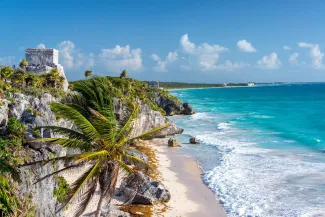
Cancun and the Riviera Maya have always been Mexico's most competitive beach market, but right now they're in an all-out pricing war that benefits anyone willing to book. This stretch of Caribbean coastline, from Cancun's Hotel Zone south through Playa del Carmen to Tulum, contains the highest concentration of all-inclusive resorts in the hemisphere, and when this many properties compete for the same travelers, deals happen fast.
The JW Marriott Cancun Resort & Spa, a property that defines five-star service in the Hotel Zone, is currently at $843 per person for three nights with flights from Houston. That's a property with a world-class spa, multiple infinity pools, and direct beach access, priced at what you'd normally pay for a mid-tier chain in Miami. The kicker? You're earning Marriott Bonvoy points on the stay, so if you're strategic about loyalty programs, you're stacking value on top of an already discounted rate.
Moon Palace Cancun, the sprawling mega-resort that's become synonymous with family all-inclusive luxury, is throwing in resort credits on top of package discounts. Recent expansions added new dining venues and upgraded pool complexes, and guests checking in now are experiencing those improvements at prices 30 percent below what early adopters paid in late 2025. The property's sheer size (over 2,400 rooms across multiple sections) means inventory is plentiful, and management is willing to discount aggressively to fill it.
Then there's Hotel Xcaret Mexico, which has redefined the all-inclusive model with its All-Fun Inclusive concept: unlimited access to Xcaret's network of eco-parks (Xcaret, Xel-Ha, Xplor, and more) is included in your stay. Normally, this added value commands a premium, but current packages are competitive with standard all-inclusives that offer no off-property perks. If you're the kind of traveler who wants more than beach lounging, who craves zip-lining through jungle canopies and snorkeling in cenotes, this is the deal that makes the most sense.
Adults-only properties are holding their value slightly better than family resorts, but they're still deeply discounted. Hyatt Zilara Riviera Maya in Puerto Morelos, positioned between Cancun and Playa del Carmen, recently completed spa additions and beachfront upgrades. It's targeting the luxury-minded couple or solo traveler who wants tranquility without kids, and at current rates (packages starting around $1,100 for four nights with flights), it's competing directly with mid-tier family properties that lack its refinement. The Luxury Collection Almare on Isla Mujeres takes the adults-only concept even further, offering an intimate island escape at $1,036 for three nights with flights from LAX; a rate that would've been unthinkable for a Luxury Collection property six months ago.
On the ground, what distinguishes these properties from their cheaper competitors isn't just the branding. The dining quality at JW Marriott and Hotel Xcaret includes chef-driven menus that rotate seasonally, not the repetitive buffet fare you'll find at budget all-inclusives. The spa facilities at Hyatt Zilara offer hydrotherapy circuits and treatments using local ingredients like agave and cacao. The room design at Almare features private terraces with ocean views and rainfall showers, not the dated tile-and-minibar setup of older resorts.
The question for travelers becomes: adults-only or family-friendly? In this pricing environment, adults-only properties offer better per-dollar value if you're traveling as a couple or solo. You're paying a slight premium (maybe $100 to $200 more per person over four nights), but you're gaining peace, refined dining, and amenities tailored to relaxation rather than entertainment. Family properties, on the other hand, maximize value for groups. Moon Palace's kids' clubs, water parks, and multi-generational suites mean one package price covers vastly more people and activities, making the per-head cost incredibly low if you're traveling with children or extended family.

Los Cabos: When to Splurge (Strategically) vs. When to Save
Los Cabos has always occupied a different tier than Cancun. Where Cancun is democratic and accessible, Cabo is aspirational and exclusive, the kind of destination where Hollywood flies in for long weekends and yacht charters outnumber fishing boats. Even in this chaos window, Cabo's pricing reflects that premium positioning, but the discounts are still substantial if you know where to look.
Solaz, a Luxury Collection Resort, perched on a clifftop with panoramic Sea of Cortez views, is at $1,868 per person for three nights with flights from LAX. In normal times, that property commands $2,500 or more for the same package. It's still not cheap, but for a resort with architecture by Sordo Madaleno (one of Latin America's most celebrated firms), a spa that integrates desert botanicals, and dining that rivals Michelin-level execution, it's a rare opportunity to access true luxury at a 25 percent discount.
If $1,868 feels steep, mid-tier sweet spots abound. Pueblo Bonito Rose Resort and Spa, an adults-only property on Médano Beach, bundles flights and four nights starting around $1,200 per person, with packages often including $100 resort credits that cover spa services or romantic dinners. Hacienda del Mar, part of the same Pueblo Bonito family, offers similar pricing with a more laid-back vibe, positioned between the rowdy Cabo San Lucas marina and the serene Corridor.
The Cabo calculus comes down to what you value. This is desert luxury; dramatic rock formations, whale-watching season (January through March), world-class golf, and dining scenes that attract chefs from Baja's wine country and beyond. You'll pay more here than in Cancun, but you're getting fewer kids, better food, and a more sophisticated atmosphere. For urban travelers who spend weekends exploring museum districts and rooftop bars back home, Cabo's aesthetic feels more aligned than Cancun's spring break energy.
Hotel Riu Palace Baja California, which completed upgrades in late 2025, represents the budget end of Cabo's spectrum. It's an adults-only property with all-inclusive rates starting at $963 for four nights with flights (departing in August or September, which are slower months). The recent renovations modernized rooms and added dining venues, so you're getting refreshed product at a discount simply because you're willing to travel during hurricane season, when weather risks are statistically low but psychological deterrents keep crowds thin.
Is the Cabo markup worth it? If you're a couple seeking sophistication, absolutely. If you're a family or group prioritizing beach time and activities over culinary subtlety, Cancun's better value. But in this pricing window, even Cabo's premium tier has become accessible to travelers who'd normally be priced out, and that's worth considering if you've been waiting for the right moment to experience it.
Puerto Vallarta & Riviera Nayarit: The Underrated Value Play
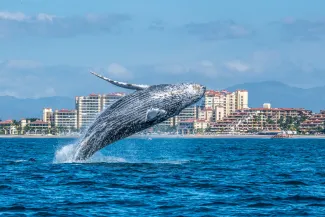
While Cancun grabs headlines and Cabo commands prestige, Puerto Vallarta and Riviera Nayarit are quietly offering the deepest discounts in Mexico's beach universe. Four-night all-inclusive packages with flights from West Coast cities are running $543 to $619, which is budget airline territory for what you're actually getting.
Riu Jalisco in Nuevo Vallarta is at $595 for four nights with flights, and this isn't some aging property limping along. Recent reviews highlight renovated pools, expanded buffet options, and beachfront that stretches for what feels like miles. The appeal here extends beyond price. Riviera Nayarit is less Americanized than Cancun; you'll hear more Spanish, see more regional cuisine on menus, and encounter cultural authenticity that's been smoothed out of Quintana Roo's tourist zones.
The Sierra Madre mountains provide a dramatic backdrop that Cancun's flat coastline can't match, and accessibility to mountain towns like San Sebastián del Oeste or the surf village of Sayulita adds dimension to a beach vacation. This is a destination where you can spend mornings exploring cobblestone streets in Puerto Vallarta's Zona Romántica, afternoons at the resort pool, and evenings watching Pacific sunsets that rival anything in the Caribbean.
Las Palmas by the Sea and Hilton Vallarta Riviera offer family-friendly options with similar pricing but different vibes. Las Palmas skews younger, with a party-adjacent energy that appeals to groups of friends or honeymooners who want beach clubs and late-night scenes. Hilton Vallarta, linked to Costco Travel packages, throws in shop card rebates that effectively reduce your net cost another $100 to $200, making it one of the best pure-value plays in Mexico right now.
Flight accessibility is where West Coast travelers win big. LAX to Puerto Vallarta is under $300 roundtrip on multiple carriers throughout February and March, and San Diego and Phoenix connections are comparably cheap. If you're based in California, Arizona, or Nevada, the flight-to-value ratio for PV packages is unbeatable. You're spending less time in transit than a Cancun trip and paying significantly less for a comparable all-inclusive experience.
The cultural dimension matters too. Puerto Vallarta's malecón (boardwalk) is lined with galleries, street performers, and restaurants serving Jalisco specialties like birria and pescado zarandeado. The Riviera Nayarit stretches north through towns like Bucerías and Punta Mita, where you'll find boutique hotels and beach clubs that cater to Mexican nationals and expats, not just package tourists. This is where you go when you want a beach vacation that feels less like a resort bubble and more like a place people actually live.
The Booking Strategy: How to Lock in Before the Rebound
Knowing the deals exist is one thing. Capturing them before they evaporate requires strategy, because pricing this volatile can shift within hours based on inventory algorithms and competitor moves.
Timing is everything. February and March departures currently offer the best inventory across all destinations, with April seeing slight upticks as spring break approaches. If you can be flexible with your travel dates, midweek departures (Tuesday through Thursday) consistently price $50 to $100 lower per person than weekend flights. Late August through October 2026 shows the absolute lowest prices ($758 in some cases), but that requires booking six to eight months out and accepting hurricane season's minimal but non-zero weather risks.
Platform playbook: each booking site has strengths you should exploit. Marriott Bonvoy Vacations is unbeatable if you're targeting Marriott properties like JW Marriott, Autograph Collection, or Luxury Collection resorts. You earn points on the package (not just the hotel portion), and elite status can unlock upgrades or late checkouts even on discounted rates. Stack this with a Marriott-branded credit card for bonus points, and you're maximizing value beyond the sticker price.
Costco Travel excels at bundling perks: shop card rebates, resort credits, and room upgrades are standard on their packages, effectively reducing your net cost 10 to 15 percent below the listed price. The catch? You need a Costco membership, but the $60 annual fee pays for itself on a single Mexico booking if you're claiming a $200 shop card and $100 resort credit.
CheapCaribbean and similar flight-and-hotel consolidators offer the lowest absolute prices on mid-tier brands (Riu, Barcelo, Decameron), but they strip out the extras. You're getting the core package—flights, transfers, all-inclusive stay—without resort credits or loyalty points. If those perks don't matter to you, this is the pure arbitrage play.
Fine print deserves obsessive attention. "All-inclusive" varies wildly by property. At premium resorts like Grand Fiesta Americana Coral Beach or Hard Rock Hotel Riviera Maya, you're getting top-shelf spirits, à la carte dining with reservations, and sometimes even spa access. At budget properties, all-inclusive might mean well brands only, limited à la carte hours, and surcharges for certain restaurants.
Read the package details line by line. Are premium spirits included or upcharged? How many à la carte reservations per stay? Is the spa included or discounted? Are non-motorized water sports (kayaking, paddleboarding) part of the package or rented separately? Properties like Atelier Playa Mujeres and SLS Playa Mujeres market themselves as ultra-luxury all-inclusive, meaning nearly everything is covered, but even they exclude certain high-end tequilas and private dining experiences.
The refundable rate gamble is worth considering. Many packages offer free cancellation up to 48 or 72 hours before departure, sometimes for a small upcharge ($50 to $100 total). In a volatile pricing environment, booking a refundable rate now locks in current prices while giving you the option to rebook if prices drop further. I've seen travelers book in January, monitor prices through February, cancel and rebook $200 cheaper in early March, then travel in April. It requires vigilance, but the savings can be substantial.
Conversely, non-refundable rates are 10 to 20 percent cheaper upfront. If your dates are locked and you're confident you'll travel, the non-refundable gamble pays off because you're capturing the absolute floor price. Just ensure you have travel insurance that covers unforeseen cancellations (medical emergencies, family issues), because once you book non-refundable, you're committed.

What About Safety? The 'Chaos' That Actually Matters
Let's address the elephant in the room: Mexico travel advisories and safety concerns. The "chaos" driving these deals is economic and logistical, not security-related, but travelers considering Mexico always wrestle with headlines about crime and State Department warnings.
As of February 2026, standard U.S. State Department advisories for Mexico remain in place, with most beach resort areas (Quintana Roo, Baja California Sur, Jalisco coastal zones) rated Level 2: Exercise Increased Caution. This is the same rating applied to France, Spain, and the UK at various times, meaning normal travel precautions apply, not blanket avoidance. The Level 3 and Level 4 warnings concentrate in northern border states and certain inland regions far from tourist corridors.
Practically speaking, Cancun's Hotel Zone, the Riviera Maya resort belt, Los Cabos' Tourist Corridor, and Puerto Vallarta's hotel zones operate with heavy security infrastructure, private transportation networks, and tourism police presence. Millions of travelers visit these areas annually without incident. The key is staying within established tourist zones and using authorized transportation; hotel shuttles, pre-arranged transfers, or resort-organized tours rather than hailing random taxis or venturing into unfamiliar neighborhoods independently.
No major closures, hurricanes, or operational disruptions are affecting beach zones in early 2026. The chaos we're capitalizing on is purely market-driven: airlines overbuilt capacity, resorts overexpanded inventory, and booking platforms are competing for market share. This isn't a distressed destination scenario where you're getting deals because something's wrong with the product. You're getting deals because supply exceeded demand at a vulnerable moment in the travel calendar, and resorts would rather fill rooms at lower margins than eat fixed costs on empty properties.
That said, informed travel requires balancing opportunity with awareness. Don't dismiss safety entirely because prices are good. Research your specific resort's location, read recent guest reviews for any security mentions, and follow State Department guidance on avoiding high-risk areas. The deal isn't worth it if you're anxious the entire trip, but for travelers comfortable with standard international precautions, Mexico's beach resorts remain safe, welcoming, and now absurdly affordable.

The Clock Is Ticking on This Window
Chaos-driven deals are, by definition, temporary. The market conditions creating Mexico's price collapse—airline overcapacity, resort inventory glut, post-holiday booking slump—will normalize as spring break demand rises, as resorts adjust inventory, and as airlines reallocate capacity to other routes. Already, I'm seeing packages that were $643 in early February tick up to $720 or $780 as March departures approach. This isn't a new baseline; it's a market correction that will revert to mean once fundamentals stabilize.
If you're ready to book, here's where to start across three budget tiers. For pure value under $700, target Seadust Cancún Family Resort or Sunscape Cancun Resort & Spa in Cancun, or Riu Jalisco in Riviera Nayarit. These deliver full all-inclusive experiences with flights for under what you'd pay for flights alone in peak season.
In the $800 to $1,200 range, focus on JW Marriott Cancun, Hyatt Zilara Riviera Maya, or Pueblo Bonito Rose in Los Cabos. You're getting luxury-adjacent product—refined dining, spa-quality amenities, adults-only tranquility—at mid-tier pricing.
For splurge-worthy experiences under $2,000, Solaz in Los Cabos and Hotel Xcaret in Playa del Carmen represent the best combination of design, service, and unique value (park access at Xcaret, architectural mastery at Solaz) that you won't find elsewhere at these rates.
This is luxury-on-a-budget travel at its finest, the kind of arbitrage that urban travelers instinctively understand. We spend our daily lives scanning for the moments when systems hiccup, when supply chains misalign, when pricing algorithms overcorrect. We book error fares, we stack credit card points, we chase hotel promotions the week before they expire. Mexico in early 2026 is that moment for beach escapes: a brief window when the machinery of travel pricing broke in our favor, and the smart money is locking in before it repairs itself.
The resorts will still be there in six months, the beaches will still be beautiful, the all-inclusive model will still function. But you'll be paying 40 percent more for the exact same experience, wondering why you didn't move when the opportunity was obvious. Don't be that traveler. The chaos window is open. Book now, travel soon, and enjoy five-star moments without five-star regret.