
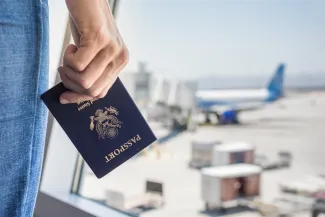
WASHINGTON — The United States passport has clawed its way back into the top 10 of the Henley Passport Index after a historic fall, but the recovery is more symbolic than substantive. The ranking, released in January 2026, shows the U.S. in tenth place with visa-free or visa-on-arrival access to 179 destinations. That's one fewer than last fall, when it held access to 180 destinations and sat at 12th place, marking the first time in the index's 20-year history that the American passport had fallen outside the top tier.
The climb back to tenth offers little comfort when you look at the bigger picture. There are now 37 countries whose citizens enjoy broader travel access than Americans, up from 36 in the fall. Over the past year, the U.S. passport recorded its steepest annual drop in visa-free access, according to Skift, underscoring a trend that has been building for more than a decade.
A Steady Decline From the Top
This is not a sudden collapse; it's the culmination of years of geopolitical friction, policy rigidity, and the rise of nations that have embraced openness as a strategic advantage. The U.S. held the number one spot jointly with the United Kingdom from 2014 through 2017. Since then, it has slid steadily downward, overtaken by Asian powerhouses like Singapore, Japan, and South Korea, as well as European nations that continue to expand travel agreements and benefit from multilateral frameworks like the EU. Singapore currently leads the index with access to 195 destinations, a commanding advantage built on decades of diplomatic engagement, economic partnerships, and a visa policy that prioritizes openness. Japan, South Korea, and several European countries occupy the spots just behind Singapore, reflecting a broader shift in global mobility dynamics that favors cooperation over unilateralism. The U.S., by contrast, has lost ground not because its citizens are restricted more often, but because other nations have gained access faster. The American passport still opens doors to the vast majority of the world, but its position relative to other wealthy democracies has weakened. Part of that is reciprocity. Countries like Brazil reinstated visa requirements for U.S. travelers in October 2023 after years of allowing visa-free entry, citing the U.S. refusal to extend the same courtesy to Brazilian citizens. India has similarly maintained restrictive policies toward American travelers while loosening requirements for citizens of nations that treat Indian passport holders more favorably.The Gap Between Inbound and Outbound Policies
The Henley Passport Index measures only one side of the equation: how freely a nation's citizens can travel. The Henley Openness Index, which tracks how many countries a nation allows in without a visa, paints a starkly different picture. The U.S. ranks 77th on that measure, allowing visa-free entry to citizens of just 46 countries. That's a policy position rooted in security concerns, immigration enforcement priorities, and domestic political realities, but it comes with costs. When the U.S. maintains restrictive inbound policies, other nations respond in kind. This dynamic has real consequences for American travelers, particularly those working in remote or developing regions where visa logistics can determine whether an assignment is feasible. A passport that requires advance visa applications for countries where competitors from Europe or Asia can arrive and begin work immediately creates friction, delays, and added expense. For photographers, journalists, and expedition operators moving through regions with limited consular infrastructure, that friction compounds quickly.What This Means for Travelers on the Ground
The practical impact of the U.S. passport's decline is unevenly distributed. Leisure travelers heading to Europe, Japan, or the Caribbean are unlikely to notice any difference. The destinations where Americans have lost access, or where new requirements have been introduced, tend to be places where visa policies are already complex or where reciprocity disputes have flared up. Brazil's reintroduction of an eVisa requirement in October 2023 is the most visible recent example. Americans can still visit, but they now need to apply online in advance, pay a fee, and manage the timing of approval, a process that adds logistical overhead for anyone planning multi-country itineraries or last-minute trips. Similar shifts have occurred in smaller markets where U.S. travelers were previously granted visa-free access but now face new requirements due to diplomatic changes or policy adjustments. For business travelers, conference attendees, and those pursuing "bleisure" itineraries that blend work and leisure across multiple countries, the cumulative effect of these restrictions adds up. A passport that offers access to 179 destinations is still powerful, but when colleagues from Germany, Canada, or Singapore have access to 190 or more, the competitive disadvantage becomes tangible.The Surge in Second Passports
One response to the U.S. passport's declining utility has been a sharp rise in Americans seeking alternative citizenship or residency by investment. Applications for second passports through programs in the Caribbean, Europe, and elsewhere surged by 67 percent through the third quarter of 2025, according to industry data. These programs, offered by countries like Portugal, Malta, Grenada, and St. Kitts and Nevis, allow wealthy individuals to acquire citizenship or long-term residency in exchange for investment, granting access to passports that often rank higher than the U.S. on global mobility indexes. This trend reflects not just dissatisfaction with travel restrictions, but a broader reassessment of the value proposition of U.S. citizenship in an era of increased global mobility. For professionals who work internationally, hold assets in multiple jurisdictions, or operate in regions where U.S. foreign policy creates complications, a second passport offers flexibility that the American document alone no longer provides. The U.S. passport remains one of the strongest in the world, but its position is no longer guaranteed. The gap between where it stands and where it once stood continues to widen, and the nations overtaking it show no signs of slowing down.About the Author

Jeff Colhoun
Jeff Colhoun is an acclaimed travel writer, photographer, and filmmaker, whose work is respected both in the United States and internationally.